
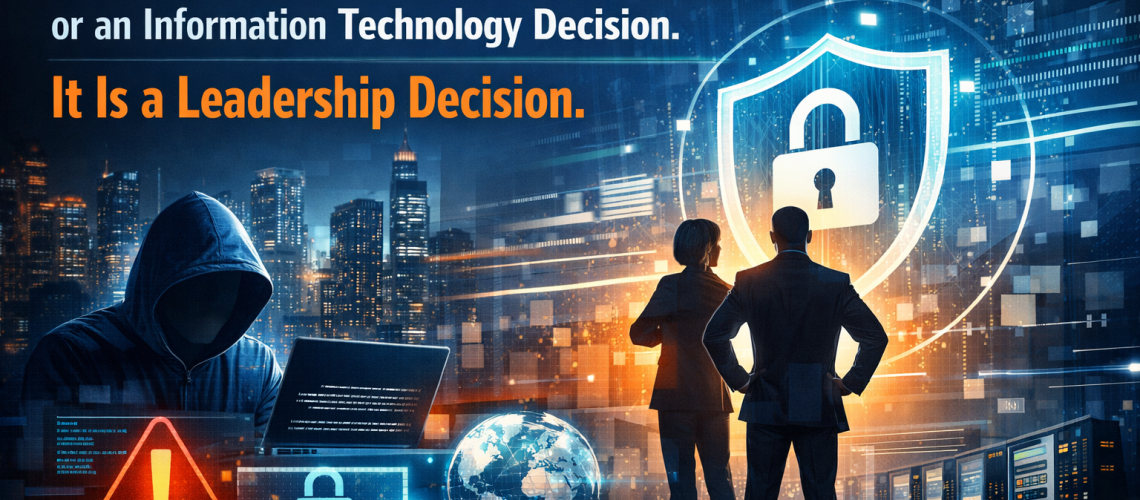
For many years, cybersecurity sat comfortably with the IT team, the system administrator or an external provider. As long as systems were running and no incidents were reported, business owners felt reassured that it was “handled”.
That separation is no longer realistic. Cyber incidents today don’t stay inside your systems. They affect operations, customers, cash flow, reputation and legal obligations. When the impact is business-wide, responsibility can’t stay with IT alone.
This guide explains why cybersecurity is a leadership responsibility, what business owners in Singapore are accountable for, and the practical steps leaders can take without needing technical knowledge.
IT Manages Systems. Leadership Owns Risk.
IT teams and providers are skilled at managing tools: servers, computers, networks and software. But cyber risk is a business risk. It involves:
- Business interruption and lost revenue
- Legal and regulatory exposure, including the PDPA
- Contractual obligations to customers and partners
- Customer confidence and reputation
- Cyber insurance cover and claims
These are leadership concerns. Delegating cybersecurity entirely to technical teams doesn’t remove responsibility. It just delays accountability until something goes wrong.
What Business Owners Are Accountable For in Singapore
Under the Personal Data Protection Act (PDPA), the organisation, not the IT provider, is responsible for protecting the personal data it holds. In practice, that means:
- Reasonable security arrangements: you must take reasonable steps to protect personal data from unauthorised access, loss or misuse.
- A Data Protection Officer: every organisation must appoint at least one DPO, and make their business contact details available.
- Breach notification: if a data breach affects 500 or more people, or is likely to cause significant harm, you must notify the PDPC within 3 calendar days of assessing that it is notifiable, and in many cases notify the affected individuals too.
- Financial penalties: the PDPC can impose penalties of up to 10% of annual Singapore turnover for organisations with turnover above S$10 million, or up to S$1 million otherwise.
Beyond the law, customers, larger partners, tenders and cyber insurers increasingly ask what security measures you have in place. Those questions land on the owner’s desk, not IT’s.
Why Cybersecurity Has Become a Leadership Issue
- Digital systems are now central to almost every business process.
- Remote and hybrid work has spread company data across homes, laptops and phones.
- Attacks now target people and passwords, not just technology.
- Downtime has an immediate impact on customers and cash flow.
- Customers and partners expect continuity and responsible handling of their data.
For the threats behind this, see Common Cyber Threats Facing Singapore SMEs in 2026.
Prepared Leaders Ask Different Questions
Leaders who treat cybersecurity as a business issue don’t ask “Do we have security software?” They ask:
- What risks are we accepting as a business?
- How long could we operate without our systems, and how much data could we afford to lose?
- What are we responsible for protecting, for our customers and under the PDPA?
- Who makes decisions during an incident?
- When did we last test that we can actually recover?
Five Leadership Responsibilities
1. Set the risk appetite
Decide, with your IT provider, how much disruption and data loss the business can tolerate. This drives backup frequency, recovery plans and budget priorities.
2. Own the minimum baseline
Make sure the essentials are in place: MFA, endpoint protection, patching, tested backups, email security and staff training. Our Cybersecurity for Singapore SMEs: A Practical Starter Guide sets out the 16-point baseline for small companies.
3. Clarify who decides during an incident
When something goes wrong, there’s no time to work out who’s in charge. Agree in advance who can authorise disconnecting systems, contacting customers, reporting to authorities and engaging specialists.
4. Fund it as a business cost
Cybersecurity is part of the cost of operating, like insurance or accounting. Budget for it every year instead of only after an incident, and use available grants to reduce the cost.
5. Review it regularly
A short cybersecurity update at management meetings, at least quarterly, keeps it visible and stops gaps from building up quietly.
Who Decides What During an Incident
| Decision | Who typically owns it |
|---|---|
| Disconnect systems or shut down the network | IT provider, with owner informed immediately |
| Engage incident response or forensics specialists | Business owner or director |
| Notify customers, partners and staff | Business owner, with agreed messaging |
| Report to the police, SingCERT and PDPC | Business owner or DPO |
| Notify the bank and cyber insurer | Business owner or finance |
| Approve recovery priorities | Business owner, advised by IT |
Write this down and keep a copy offline. For the steps that follow, see our guide on what to do after a ransomware attack.
A 15-Minute Quarterly Cyber Review
You don’t need a security committee. Add these questions to a regular management meeting:
- Have there been any incidents, near misses or suspicious emails this quarter?
- Are backups running, and when was the last successful restore test?
- Is MFA on for every email, cloud and admin account?
- Are all computers and servers up to date and protected?
- Have any staff joined or left, and were their accounts set up or removed properly?
- Is there anything on the security baseline we still haven’t done?
Leadership Sets the Tone
Culture follows leadership. If leaders treat cybersecurity as a cost, teams minimise effort. If it’s a checkbox, reviews become superficial. If it’s someone else’s problem, ownership disappears.
When leaders treat it as a business responsibility, clarity improves, decisions become proactive and teams align. Preparedness isn’t enforced. It’s signalled from the top.
Support for Business Owners
- CSA publishes cybersecurity toolkits for enterprise leaders and SME owners, written for business leaders rather than IT specialists.
- Eligible SMEs can get up to 50% grant support for Acronis Endpoint Security, Acronis Backup and Microsoft 365 Backup. See our EDGE grant guide.
- Ostendo provides Acronis Endpoint Security, Acronis Backup, Microsoft 365 Backup and day-to-day IT support for Singapore SMEs.
Frequently Asked Questions
Is cybersecurity the responsibility of the IT team or the business owner?
IT manages the tools, but the business owner is accountable for the risk. Under the PDPA, the organisation is responsible for protecting the personal data it holds, even if IT is outsourced.
Do SMEs need a Data Protection Officer?
Yes. Every organisation covered by the PDPA must appoint at least one Data Protection Officer and make their business contact details available. In a small company, this is often the owner or a senior manager.
What happens if my business has a data breach?
You must assess the breach. If it affects 500 or more people or is likely to cause significant harm, notify the PDPC within 3 calendar days of that assessment, and usually the affected individuals too. Penalties can apply if reasonable security arrangements weren’t in place.
How much should an SME spend on cybersecurity?
It depends on your size, data and risk appetite. Start with the minimum baseline, many parts of which cost little beyond setup, then prioritise based on what would hurt the business most. Grants can offset part of the cost.
How often should management review cybersecurity?
At least quarterly, with a short standing agenda item, plus an annual review of the whole security baseline and incident response plan.
Start With a Clear Picture
Leadership begins with knowing where you stand. WhatsApp Ostendo on +65 9457 3538 for a plain-language review of your current setup, or download our Cyber Resilience Checklist below to frame the conversation with your management team.
Checklist: Seven Essentials for Cyber Resilience and IT Optimization
In today’s fast-paced digital landscape, SMBs face unique challenges in managing their IT infrastructure.
This checklist is designed to help you score and identify where you stand regarding cyber resilience and what areas in your organization lack expertise, resources and experience regarding IT support, and partnering with an MSP like us, is crucial.
Fill out the form to download the checklist today!
