
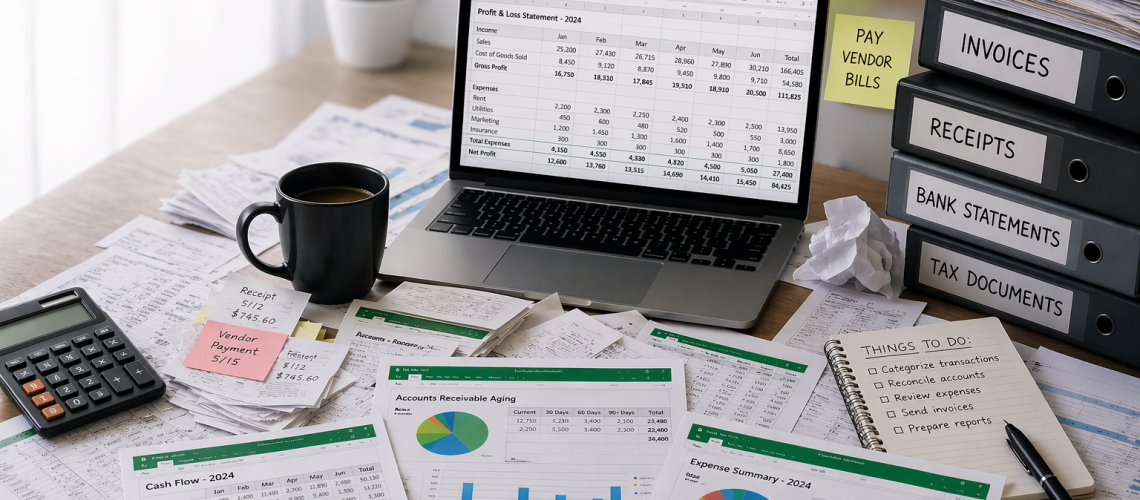
What is bookkeeping?
Many small businesses start out managing their finances in simple ways. Some use notebooks, some rely on Excel spreadsheets, and others keep bits of information across different files and folders. At the beginning, this may seem manageable. But as the business grows, keeping track of financial records becomes more important and often more difficult.
This is where bookkeeping comes in.
Bookkeeping is the process of recording and organizing a business’s financial transactions. This includes sales, purchases, expenses, customer payments, supplier payments, cash flow, bank transactions, and in many cases, inventory records as well. In simple terms, bookkeeping helps a business keep a clear and accurate record of what is happening financially.
For many small businesses and startups, bookkeeping is often seen as just an admin task. But in reality, it plays a much bigger role. Proper bookkeeping helps business owners understand how the business is performing, where money is going, what is coming in, and what needs attention.
Without proper bookkeeping, even simple questions can become hard to answer. A business may struggle to know how much it spent last month, which products are moving faster, whether customer payments are being collected on time, or whether stock records are accurate. When financial information is not organized, business decisions often end up being made based on guesswork rather than facts.
Good bookkeeping creates clarity.
When records are maintained properly, businesses can review income and expenses more accurately, monitor cash flow, stay organized with customer and supplier details, and prepare reports more easily. It also helps business owners look back at past financial data and use that information to make better decisions for the future.
This is especially important for small businesses and startups. Past financial records can help reveal patterns, highlight high-expense periods, show sales trends, and support better planning. Instead of reacting to problems only after they happen, businesses can make more informed decisions earlier.
One common challenge many businesses face is relying too heavily on manual spreadsheets. Excel can be useful in the early stages, but as operations grow, spreadsheets can become harder to control. Duplicate entries, outdated file versions, accidental changes, missing information, and formula errors can affect accuracy and create confusion. The same problem happens when customer records, supplier records, inventory details, and expense tracking are all kept in separate places.
That is why structured bookkeeping becomes more important as a business grows.
A more organized accounting system can help businesses keep their records in one place, improve visibility, reduce manual work, and make reporting easier. Instead of spending hours updating spreadsheets and checking for mistakes, teams can focus more on running the business and planning ahead.
Bookkeeping is not just about recording the past. It helps businesses understand the present and prepare for the future. For small businesses, it is one of the foundations of better control, better reporting, and better decision-making.
If your business is still relying on scattered records or manual tracking, it may be time to look at a more structured way to manage your accounts and inventory.
