
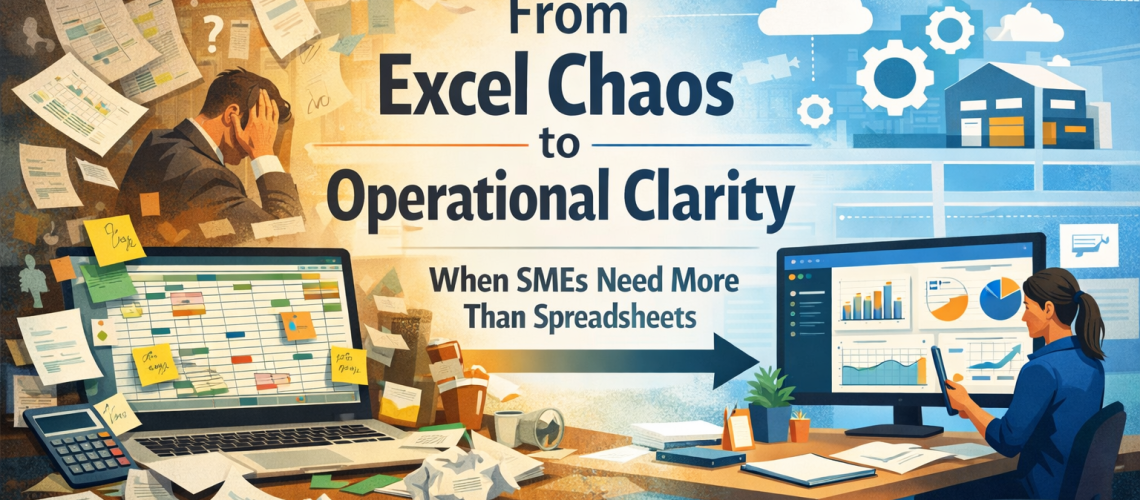
From Excel Chaos to Operational Clarity: When SMEs Need More Than Spreadsheets
Spreadsheets have helped countless businesses get started. They are familiar, flexible, and easy to use. For a small operation with limited transactions and a simple structure, they can work well.
But what works in the early stages does not always continue working as the business grows.
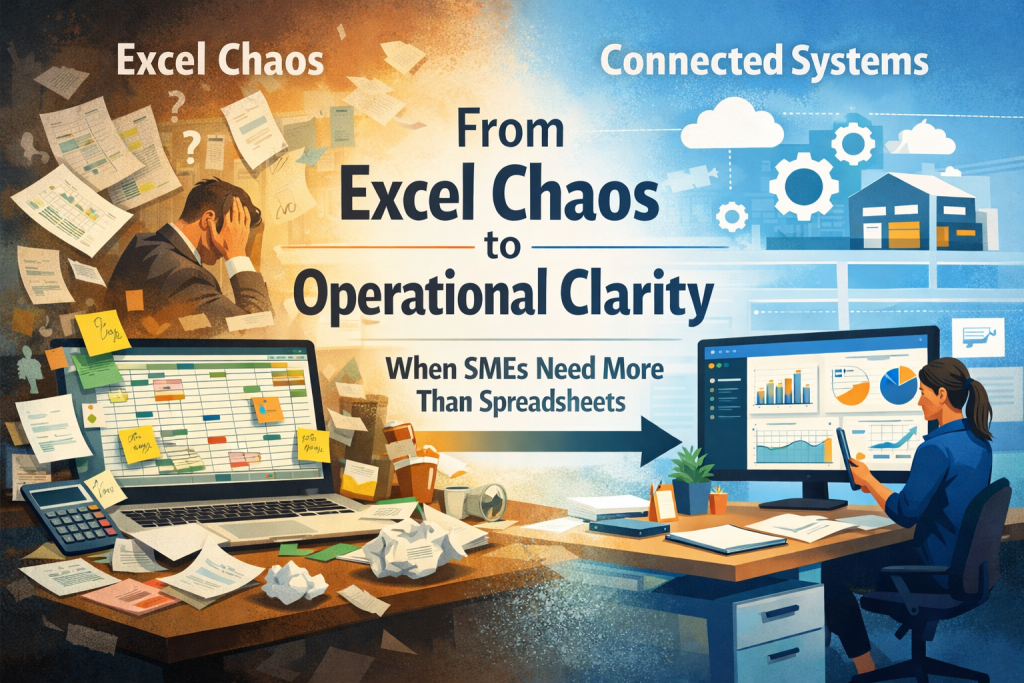
As more customers come in, more staff join the team, and more departments become involved, spreadsheets often begin to create more confusion than control. What once felt simple starts becoming fragmented. Files multiply. Different teams track information in different ways. Updates become slower. Errors become easier to make.
This is where many SMEs begin to experience what feels like operational chaos.
The problem is not Excel itself. The problem is when the business has outgrown spreadsheets, but the system has not changed.
Why Spreadsheets Work in the Beginning
In the early phase of a business, spreadsheets are often enough because the business is still simple. There are fewer people involved, fewer transactions to manage, and fewer processes that need to stay connected.
The same person may handle sales updates, stock movement, purchasing decisions, and basic reporting. In that kind of environment, the spreadsheet still reflects what is happening closely enough to support daily work.
That is why many businesses become comfortable relying on spreadsheets for a long time.
But growth changes everything.
What Changes as the Business Expands
As the business becomes more active, different functions begin to branch out. Sales may keep one file. Inventory may have another. Purchasing tracks different details. Finance works from its own records. Operations may depend on information that has already changed before the latest file is shared.
This is when silos start to form.
Different teams are working, but they are not always working from one connected picture. Decisions begin to depend on partial information. Reporting takes longer. Leaders need to ask more questions just to understand what is current and what is not.
Eventually, the business becomes reactive. Instead of planning ahead confidently, the team spends time checking, reconciling, and correcting.
The Real Problem Is Visibility
Many operational issues are actually visibility issues.
When data lives in too many places, no one has the full picture in real time. Teams may be trying their best, but if information is outdated, duplicated, or disconnected, even simple tasks become harder.
This often shows up in small but costly ways. Sales may quote based on old stock information. Purchasing may reorder too late. Finance may wait for updates from multiple sources before closing a report. Management may receive numbers that need further checking before action can be taken.
The result is not only inefficiency. It is stressful.
Leaders feel like they are constantly chasing clarity. Teams feel busy, but progress still feels slower than it should.
What Operational Clarity Looks Like
Operational clarity happens when the business is no longer dependent on scattered files and disconnected updates.
It means different departments are working from a more connected source of truth. Sales, stock, purchasing, production, and finance are better aligned. Information becomes easier to access and easier to trust.
When operational clarity improves, planning becomes more proactive. Teams know what needs attention sooner. Errors are reduced. Duplication decreases. Leaders spend less time confirming and more time deciding.
This does not mean every spreadsheet must disappear overnight. It means the business should no longer depend on fragmented tools to function well.
Signs Your Business Has Outgrown Spreadsheet Dependency
There are several common signs that a business may be relying too heavily on spreadsheets.
One is when there are multiple versions of the same file and no one is fully sure which one is current. Another is when staff keep re-entering the same information into different places. Delayed reporting, stock mismatches, repeated checking across departments, and reactive planning are also strong signals.
These are not minor inconveniences. They are signs that the business needs more structure and more visibility to keep growing well.
Better Systems Create Calmer Operations
A stronger operational setup does not just improve efficiency. It changes the way the business feels to run.
Teams spend less time hunting for information. Planning becomes clearer. Leaders gain a better view of what is happening now and what may need attention next. Daily work becomes smoother because the business is less dependent on manual coordination.
This is the true move from Excel chaos to operational clarity.
The goal is not to criticise spreadsheets. It is to recognise when they are no longer enough and when the business needs a more connected way to operate.
Growing businesses deserve systems that support growth, not systems that struggle to keep up with it.
